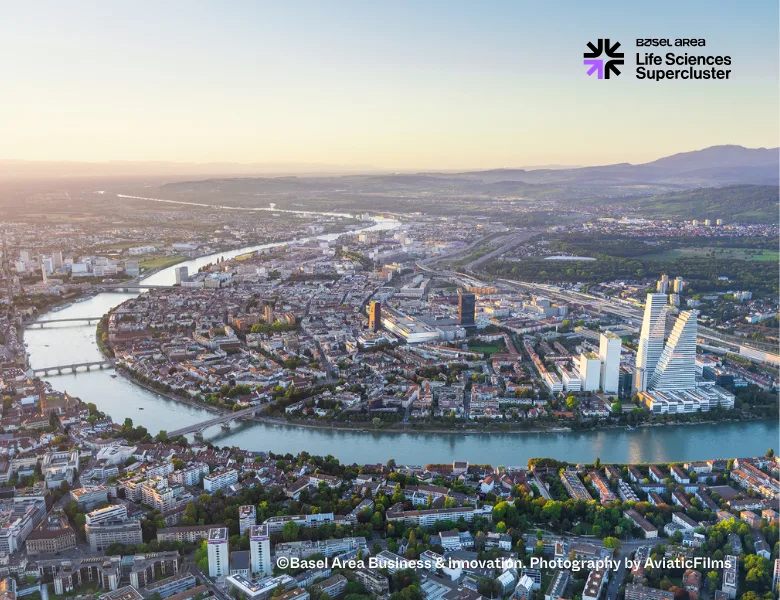
Research institutes in the Basel Area: your guide to Europe’s life sciences R&D hub
If you’re evaluating where to anchor your next phase of life sciences growth, research capability will be near the top of your checklist. Access to academic partners, shared infrastructure, and clinical proximity can determine how fast you move from pipeline to patient – and on all of these measures, the Basel Area stands apart.
Research institutions in Switzerland have placed the country first in the Global Innovation Index for 15 consecutive years, and nowhere is that density of research capability more concentrated than in the Basel Area.
Why research in Basel Switzerland is different
The Basel Area Life Sciences Supercluster brings together more than 800 companies, 1,000+ research groups, and nearly 35,000 professionals, making it one of the highest concentrations of life sciences expertise anywhere in the world.
The region draws researchers, clinicians, and scientists from across Europe and beyond and tends to keep them. And as one of the top tanked cities in the world for quality of life, Basel holds onto talent in a way few research destinations can match.
Aside from talent, one of Basel’s greatest research advantages is proximity. Industry leaders, startups and research teams operate within a tightly connected geography. Roche, Novartis, Moderna, Bayer and hundreds of other companies sit minutes from world-class labs, hospitals and research institutes. That density fuels the infrastructure, investment and collaboration that help innovation move faster.
As one ETH Zurich professor put it, Basel draws parallels with North American clusters like Boston and the San Francisco Bay Area in the depth and velocity of its biotech activity.
The 17 Basel Area research institutes you should know
These institutions form the backbone of research in Basel and help power collaboration between academia and industry.
Biozentrum — University of Basel
One of the world's leading molecular life sciences institutes, the Biozentrum has been the birthplace of fundamental discoveries in biology and medicine, producing several Nobel Laureates. Its 14 research areas span neuroscience, structural biology, genomics, and systems biology. Commercial partners include Novartis, Roche, Basilea Pharmaceuticals, and BioVersys, with six spin-offs to date.
Botnar Institute of Immune Engineering (BIIE)
The Botnar Institute of Immune Engineering (BIIE) is a newly founded non-profit research organisation advancing immune engineering to improve child and adolescent health worldwide. Backed by more than US$1 billion in philanthropic investment over 15 years, it is partnering with ETH Zurich and the University of Oxford and will open a purpose-built campus at Switzerland Innovation Park Basel Area in 2027.
CSEM - Swiss Center for Electronics and Microtechnology
A public-private technology innovation center with six Swiss sites, CSEM transfers advanced technologies in precision manufacturing, digitalization, and sustainable energy directly to industry. Its Tools for Life Sciences division offers specific capabilities in biosensors, microfluidics, AI, robotics, and system-on-chip development. Works with companies from startups to multinationals, as well as academic institutions across the Basel Area.

Department of Biomedicine (DBM) — University of Basel
A joint venture of the University of Basel and University Hospitals Basel, the DBM bridges basic and clinical research across immunology, neurosciences, cancer biology, and tissue regeneration. It operates accredited GMP facilities for advanced therapy medicinal products. Several spin-outs have emerged from its research, including Cimeo Therapeutics and Hornet Therapeutics.

Department of Biosystems Science and Engineering (D-BSSE) — ETH Zurich
ETH Zurich's Basel outpost focuses on engineering complex biological systems from the nanoscale up, with strong application to precision medicine and personalized health. D-BSSE co-leads key industry consortia including the Next-Gen Bioengineers Partnership with Roche and the Engineering Translational Medicine (ETM) initiative. Located on campus Schällemätteli, directly adjacent to the University of Basel and University Hospital Basel.
Department of Clinical Research (DKF) — University of Basel
Located at University Hospital Basel, the DKF supports the full lifecycle of clinical research, from trial design and execution through to data governance and health economic evaluation. Its Outpatient Study Centre provides Phase I–III infrastructure. With 139 clinical research groups and over 1,090 publications per year, it is one of Switzerland's most active clinical research departments.
Department of Pharmaceutical Sciences (DPhS) — University of Basel
Spanning the full drug development chain from discovery to application, DPhS bridges the Faculty of Science with clinical medicine and brings AI tools into drug discovery. Its century of institutional history includes the Nobel Prize-winning discovery of cortisone by then-director Tadeus Reichstein. Research collaborations extend to pharmaceutical companies and universities across Switzerland and internationally.
Department of Biomedical Engineering (DBE) — University of Basel
A joint venture between the University Hospitals of Basel and the Medical Faculty, DBE applies engineering to healthcare challenges — from biomaterials and surgical robotics to medical imaging and forensic technologies. Core facilities include micro and nanotomography and a 3D-print lab. Industrial partnerships and research collaborations span the global network.

FHNW School of Life Sciences
The FHNW School of Life Sciences is the applied sciences counterpart to Basel's more research-intensive universities, with a deliberate 50/50 split between industry collaboration and education. Most professors have prior industry experience, and the institution operates infrastructure designed for commercial application rather than basic science alone. Research areas cover chemistry and bioanalytics, pharma technology, medical engineering, and ecopreneurship. Partners include PEARRL, PerTPV, InPharma, and NextGen.
Friedrich Miescher Institute for Biomedical Research (FMI)
A world-class biomedical research institute affiliated with both the University of Basel and the Novartis Institutes for Biomedical Research, FMI focuses on genome regulation, multicellular systems, and neurobiology. Its 19 research groups conduct deep basic science with high publication impact and a strong patent track record.
Haute Ecole Arc (HE-Arc)
The university of applied sciences for cantons Jura, Neuchâtel, and Berne, HE-Arc specializes in diagnostic and interventional medical devices, wearables, biosensors, organ-on-chip systems, and AI-based chronic disease monitoring. Active in the Switzerland Innovation Park Basel Area in Delémont, it works with partners including CSEM, Melexis, and CNS Therapy.
Institute of Human Biology (IHB) — Roche
Launched in 2023 as part of Roche's pharma R&D engine, IHB advances organoid technology and human model systems to accelerate drug discovery and precision medicine. With more than 35 nationalities on staff and a joint doctoral programme with ETH Zurich's D-BSSE, it represents the cutting edge of translational research in Basel.
Institute of Molecular and Clinical Ophthalmology Basel (IOB)
The Institute of Molecular and Clinical Ophthalmology Basel brings basic researchers and clinicians together to advance understanding of vision and develop new therapies for vision loss. It maintains close ties to the University of Basel and the University Hospital Basel Eye Clinic, alongside a global network of academic and industry partners. Its first spin-off, RhyGaze AG, is advancing gene therapy for blindness.
Paul Scherrer Institute (PSI)
The Paul Scherrer Institute is Switzerland's largest research institute for natural and engineering sciences, operating complex large-scale facilities used annually by more than 2,100 scientists from around the world. Research covers future technologies, energy and climate, and human health. Located between Zurich and Basel, PSI maintains extensive national and international industry collaborations.
Swiss Institute of Bioinformatics (SIB)
The Swiss Institute of Bioinformatics is an internationally recognized non-profit dedicated to biological and biomedical data science. It provides databases, software platforms, biostatistics services, and sensitive data-sharing infrastructure to academic, clinical, and commercial partners worldwide. With 25+ years of experience and partnerships ranging from biotech startups to major pharma companies, it is a critical digital infrastructure provider for research in Switzerland.
Swiss Nanoscience Institute (SNI) — University of Basel
The Swiss Nanoscience Institute is the Basel Area's center of excellence for nanoscience and nanotechnology, providing nanoimaging and nanofabrication services with applications across life science, medicine, materials science, and quantum science. Its Nano-Argovia program funds applied research by network members and companies. Over the last four years it has cooperated with more than 25 companies including Institute Straumann, Dectris, and TargImmune Therapeutics.
Swiss Tropical and Public Health Institute (Swiss TPH)
Associated with the University of Basel, the Swiss Tropical and Public Health Institute is a global leader in infectious and non-communicable disease research with a focus on low- and middle-income country health. It covers the entire value chain from innovation through to application, with active partnerships spanning Novartis, Roche, Bayer, the Bill & Melinda Gates Foundation, and the World Health Organization.
Join Basel Area’s innovation ecosystem
The research infrastructure in Basel Area is the product of decades of coordinated investment by the Swiss federal government, the cantons, and private industry. The result is a 60-minute radius of R&D and talent excellence that helps get you from research to execution to commercialization quickly.
For life science companies evaluating where to place an R&D function, a clinical operation, or a European headquarters, our team offers free, personalized support at every stage of the decision process — from initial scoping and site visits through to setup and beyond.
Get in touch to see how we can support your growth.
Related Insights

How the Supercluster fuels Immune Engineering research

Commercialization playbook: lessons from BIO 2026 on scaling globally