
Why European expansion planning starts before commercialization


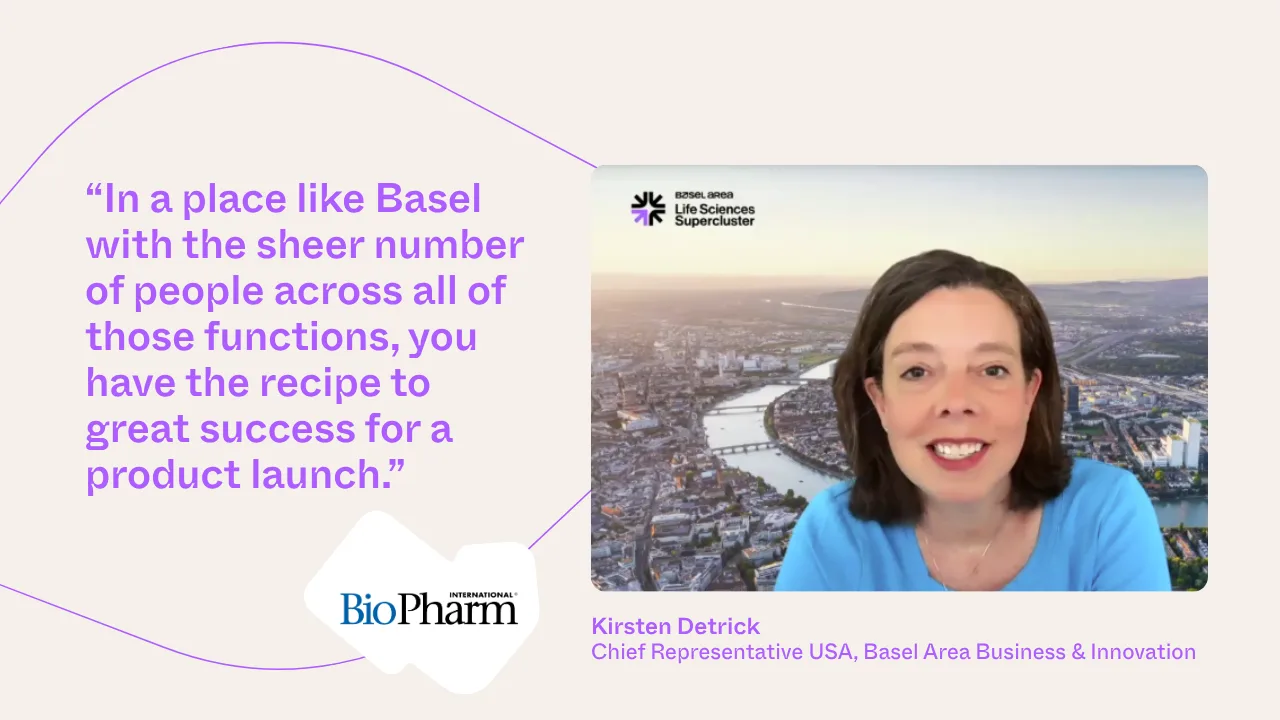
Expanding into Europe creates significant opportunities for U.S. biotech companies, but it also introduces new decisions around where to establish and how to approach commercialization. In the interview series with Biopharm International, Kirsten Detrick, Chief Representative USA at Basel Area Business & Innovation, shares two considerations companies should address early when planning their European expansion.
Choosing the right location therefore starts with a more fundamental question: what drives your business? Competitive tax rates and quality-of-life incentives can make a location attractive, but long-term growth and revenue ultimately depend on having access to the right talent.
For companies moving toward commercialization, this means looking at where they can find experienced professionals who understand how to build a life sciences business and navigate European markets.
Bringing market access expertise on board early
Access into the European market is complex. While Europe has a centralized regulatory for approval, pricing and reimbursement frameworks differ between individual countries. Companies therefore need to understand the requirements of each market rather than approaching Europe as one commercial market.
With companies often heavily focused on Phase III clinical development, bringing in the experts who can help navigate European market access can easily be overlooked. According to Detrick, companies often wait too long to involve experienced pricing, reimbursement and market access professionals. Bringing this expertise on board earlier can help them understand the requirements of individual markets and integrate these considerations into their development and commercialization plans. With its concentration of experienced pharmaceutical and biotech talent, the Basel Area provides a deep concentration of this expertise, giving companies access to professionals who have navigated European market access and product launches in Europe before.
Read the article here.
“We have nearly three times the number of people who have done this before in a commercial setting in Basel than in any other area in Switzerland.”


Thinking beyond clinical development earlier
As biotech companies move closer to commercialization, they need to think beyond clinical development. Questions around the value of a therapy, real-world evidence and health economics often come up much earlier, especially when preparing to enter European markets. Addressing these questions early can help companies prepare for future discussions with health authorities and payers.
According to Detrick, recognizing that these considerations need to be thoughtfully evaluated and incorporated earlier is an important step in a company’s maturity. Rather than treating market access and commercialization as the next step after development, companies can begin building the evidence and strategies they will eventually need while development is still underway.
Cross-functional talent as a key factor for a strong biotech hub
For emerging areas such as oncology, cell and gene therapies and precision medicine, the combination of cross-functional talent becomes particularly valuable when preparing for commercialization. Companies need commercial professionals who understand the science and can translate it into business opportunities, alongside people who have experience navigating different payer systems and understand how these perspectives connect.
Bringing together expertise not only from commercial and market access functions, but also from R&D, manufacturing and other teams, brings different perspectives to the question “how a therapy moves from development toward patients”. The cross-functional approach that the mix of talent working together helps break down silos between teams and enables companies to navigate commercialization more efficiently.
The Basel Areas Life Sciences Supercluster brings together both, the density of expertise and the mix of its life sciences talent. Generations of pharmaceutical innovation around companies such as Roche and Novartis have contributed to a talent pool spanning scientific, development, manufacturing and commercial functions. According to Detrick, this scale and mix of life sciences talent is difficult to find elsewhere in Switzerland or Europe.
“The most important secret to success is cross-functional talent working together.”
But experience is only part of the equation. The region also attracts people who are open to new ideas and opportunities and comfortable working across different environments. Professionals can move between established global pharmaceutical companies, emerging biotechs and startups, bringing their experience and perspectives into different settings. This combination of expertise, flexibility and an entrepreneurial mindset strengthens the cross-functional collaboration that growing biotech companies need as they move new therapies toward market.
Read the article here.
You may also be interested in…

Alentis and CSL strike partnership worth up to US$1.55 billion to advance treatments for rare disease

Basel recognized among the world’s top emerging biotech hubs in 2026
